
The Wanderer: The True-Life Story of Anthony Dubois
- The Wanderer
- Aug 17
- 21 min read
The Wanderer
The strange road of Anthony Dubois, the traveler whose accumulated experiences would eventually become the public world of Lucian Seraphis: writer, researcher, Occult philosopher, intuitive spiritual reader, published author, craftsman, and systems-oriented analyst.
This is not a conventional chronology. Anthony moves, stops, meets people, listens, tells stories, gets things wrong, learns, and moves again. Memory determines the route. A desert fire may open into a hospital room. A song may lead to a discussion of political power. A broken pendant may become a lesson about evidence. A stranger may ask one question and send him forty years backward.
The larger public archive, current books, services, writing, and projects are collected at Lucian Seraphis Enterprises.
A Man Who Learned to Stop
Anthony Dubois had discovered that there were two kinds of people on the road: those who wanted to know where you were going, and those who wanted to know where you had been. He preferred the second kind. Where he was going was usually a question with no satisfactory answer.
That evening he stopped because his feet hurt. There was no revelation involved. No guiding star. No mysterious voice instructing him to rest beneath a particular tree. His left foot simply hurt like hell, and experience had taught him that the body eventually wins every philosophical argument.
So Anthony sat. The road stretched in both directions, disappearing into distances that looked remarkably similar despite supposedly leading to entirely different places. He had traveled enough of them to become suspicious of destinations.
A man sitting nearby looked over. He had the posture of someone who had been waiting for nothing in particular for a very long time.
You walking?
Anthony looked down at his boots. 'I've found it more effective than waiting for the Earth to rotate beneath me.'
The stranger stared at him. Anthony sighed. 'Yes. I'm walking.'
Where to?
'There it is,' Anthony said.
There what is?
'The question.'
The stranger laughed, which was enough for Anthony to decide that he might be worth talking to.
They shared coffee from a thermos. It was terrible coffee, which meant it was authentic road coffee. Good coffee required the kind of stability Anthony had not always possessed.
You always travel alone?
'No.'
Where's everybody else?
'Most of them kept going.'
That was true in more ways than Anthony intended. There had been a great many people. Some stayed beside him for years. Others lasted an evening. A mystic by the ocean. A con man beneath a desert sky. A homeless man called Legend who taught him how cities actually worked. Preachers. Musicians. Witches. True believers. Professional skeptics. Men who lied beautifully. Women who saw things they could not explain. People who could explain everything and therefore understood almost nothing.
Anthony had learned from all of them. Unfortunately, he had also learned from himself. That had been considerably more expensive.
Before the Road
There had been a time when Anthony was not a wanderer at all. He had been an athlete, popular, physically confident, moving through the social world with the easy certainty of someone whose body and future seemed to have reached an agreement.
Run. Turn. Jump. Hit. Get up. Keep going. The body answered before the mind needed to ask.
Then came the wreck.
People later described the brain injury in clinical language. Clinical language has its uses. It also has the peculiar ability to make catastrophe sound like paperwork. From Anthony's side of the event, the injury had not happened merely inside his skull. It had happened to the architecture of reality.
The person who entered the wreck and the person who eventually emerged were not quite the same man. Words hid. Movement demanded attention. Social ease became observation. The old future disappeared without leaving a forwarding address.
At first Anthony thought the task was to become the boy he had been. Years later he would recognize this as his first serious systems error: attempting to restore conditions that no longer existed.
The old self could not simply be reinstalled. Something else began organizing itself instead.
Observation became important because participation was no longer effortless. People contradicted themselves. They claimed one value and behaved according to another. Institutions developed recognizable behaviors even when nobody inside them seemed to be directing the whole. Religion could make frightened people brave and intelligent people obedient. Love could make skeptics superstitious. Money could make moralists flexible. Trauma could rearrange the priorities of an entire life.
Anthony did not yet call any of this systems analysis. He was trying to understand why the world no longer worked the way he remembered.
The Crossings
Then death became personal.
Anthony would have two near-death experiences. One was brief. The other lasted roughly five minutes. He experienced what he understood as being on the other side and returned with the uncomfortable knowledge that a subject most people discussed abstractly had ceased to be abstract for him.
Five minutes is nothing when waiting for a bus. Five minutes is an entirely different measurement when the ordinary world has stopped.
The experiences did not hand Anthony a complete cosmology. They did something more disruptive: they made certainty difficult. He could no longer easily accept someone else's assurance that reality contained only what current explanation could accommodate. At the same time, he eventually became equally suspicious of people who transformed every unexplained experience into proof of whatever they already wanted to believe.
Experience is real. Interpretation is work.
That distinction would follow him for the rest of his life.
The Mystic by the Ocean
For four years in a beach town, Anthony spent time with a Christian mystic he came to think of as St. Peter. Peter was not interested in making Christianity smaller. His conversations wandered through mysticism, Eastern thought, symbolism, consciousness, and music.
YES and RUSH entered Anthony's education as something more than bands. Their complexity, symbolism, philosophical language, and spiritual atmosphere turned music into another kind of scripture—not because the records demanded belief, but because they opened questions.
Peter taught Anthony that belief could expand rather than contract the mind. A spiritual life did not have to consist of repeating inherited answers. It could be an investigation.
Many years later, the Gothic Philosopher would still carry that lesson: a closed mind can become a trap with the door locked from the inside.
The Preacher
For a time Anthony became a wandering preacher, moving from town to town. He thought he was carrying something to people. The road corrected that assumption.
Every congregation contained another version of God. There was the God of the frightened mother. The God of the man bargaining with addiction. The God of the old woman who had buried almost everybody she loved and remained kind. The God of the preacher who watched the collection plate too carefully. The God of the skeptic who insisted he believed in nothing but became furious when someone challenged his assumptions.
Anthony discovered that the most important conversations often began after the sermon, when the chairs were emptying and somebody remained behind.
A person would tell him about a marriage, a fear, a death, a betrayal, a dream, a child, a secret, an addiction. Anthony began listening more carefully than he preached.
Eventually he understood one of the great defects of preaching: the preacher is often facing the wrong direction. The interesting stories are sitting in the chairs.
The ability to persuade someone is not evidence that what you are saying is true.
That lesson would return years later in politics, cult investigation, advertising, propaganda, and eventually artificial intelligence.
The Cult Investigator
Southern California brought Anthony into contact with a man who had worked around Christian cult investigation. Anthony had already seen what belief could give people. Now he began seeing what people could do with belief.
The investigator talked about charismatic leaders, recruitment, fear, doctrinal traps, manipulation, and the dangerous moment when questioning a leader became evidence that the follower was morally defective.
Peter had taught Anthony to open doors. The cult investigator taught him to look at who was standing behind them.
The distinction that stayed with him was surprisingly simple: a mystic might tolerate the sentence 'I don't believe you.' A manipulator often could not.
Anthony would later encounter the same structure outside religion. Political movements, ideological communities, corporations, online tribes, conspiracy cultures, and even scientific communities could become closed systems when disagreement ceased to be information and became evidence of disloyalty.
Tony in the Desert
There was Tony.
Anthony camped with him in the desert. Tony was a con man. Tony was also spiritual. The two facts coexisted in him with a serenity Anthony found both fascinating and infuriating.
At night the desert removed distractions. The horizon disappeared and the stars became absurdly large. Tony could talk about God, spirits, fate, human nature, and the moral responsibilities of consciousness with startling sensitivity.
Then morning would come and Tony would attempt to manipulate somebody.
Anthony learned something from that contradiction that no religious textbook had ever managed to teach him: spiritual insight and moral character are not the same thing.
A con man reads people. He notices desire, vanity, fear, loneliness, greed, hope, and the small inconsistencies people reveal while believing they are saying something else. Then he builds a story capable of entering through the opening.
The difference between seeing into another person and exploiting what you see is an ethical decision.
Years later, when Anthony became an intuitive reader, Tony remained somewhere in the back of his mind. Reading people was never enough. The question was what you did with what you noticed.
Legend
When Anthony was homeless in the city, a man everyone called Legend took him under his wing.
Homelessness has rules invisible to people who always know where they will sleep. Where can you sit without being moved? Which corner belongs to someone? Which place is safe after dark? Who is bluffing? Who is dangerous? What should never leave your sight? How long can a cup of coffee become permission to remain indoors?
Legend knew the city at that level.
He taught Anthony the ropes without making the lessons sentimental. Survival first. Philosophy could wait.
One day Anthony saw a drunken older man being harassed by a thug and stepped in. It was not a carefully reasoned moral decision. There are moments when the mind provides a list of reasons to mind your own business and something deeper answers no.
Later another man came after Anthony. This time Anthony understood the threat clearly. He had his knife ready. Before the man could reach him, Legend intercepted him.
The moment was brief. Nobody became a hero. Nobody received a medal. They went back to being homeless.
But Anthony never forgot the structure of what had happened. He had stepped between danger and an old drunk who could not defend himself. Later Legend stepped between danger and Anthony.
When somebody beside you cannot stand alone, you stand with them.
Years later Anthony would encounter philosophers who needed hundreds of pages to discuss social obligation. Legend had explained it in seconds.
All Points in Between
Arizona. Georgia. Ohio. California. The Carolinas. And all points in between.
Anthony stopped thinking of geography only as state lines. Arizona became heat and distance. Ohio became cold sky and movement. California became reinvention, danger, strange teachers, and improbable conversations. Georgia eventually became somewhere closer to home. Between them were truck stops, diners, cheap rooms, couches, shelters, parking lots, churches, libraries, desert camps, highways, and houses where he stayed long enough to recognize the plumbing but not long enough to remember the address.
The road had its own population. Runaways. Musicians. Veterans. Addicts. Hustlers. Preachers. Witches. People escaping marriages. People escaping themselves. Men who claimed to know God. Women who claimed to know things about Anthony. Skeptics who believed impossible things. Believers who doubted everything.
He learned that status tells you remarkably little about whether a person understands anything. He met intelligent people with almost nothing and fools with impressive credentials. He met criminals with codes and respectable men without them. He met mystics who were frauds and frauds who accidentally said something profound.
Eventually I stopped thinking of the miles as the distance between important places. The miles were the important place.
The Vow
In 2007 Anthony took a vow of celibacy.
It was not a declaration that sexuality was evil. It was an act of withdrawal from one of the strongest organizing forces in adult life. Anthony wanted to know what remained when attraction, pursuit, romance, jealousy, possession, validation, and the need to be desired were no longer allowed to determine the route.
The vow became another kind of road: less geographical, more interior.
Injury had disrupted identity. Homelessness had disrupted status. Death had disrupted certainty. Celibacy disrupted desire. Each subtraction changed what Anthony could see.
The Minister
The wandering preacher eventually entered formal theological and esoteric study, completed a religious doctorate, and entered ordained interfaith ministry. By then he had already accumulated too many questions to fit comfortably inside a narrow theology.
Christian mysticism had something to say. Gnosticism had something to say. Rosicrucian thought had something to say. Eastern traditions had something to say. Psychology had something to say. The Occult had something to say. Science had something to say. Sometimes a stranger at three in the morning said something none of them had managed to express as well.
The title did not make Anthony more certain. If anything, the journey had taught him to distrust the kind of certainty that requires other people to stop asking questions.
The Music Road
Then there were the musicians.
Anthony began writing music reviews. At first the audience was small. Eventually musicians began finding him, sending songs, talking about their work, and allowing him into parts of the creative process.
He was not very good at remaining inside a music review. A guitar line could send him into economics. A lyric about loneliness could become psychology. Punk could become a theory of cultural change. A distributed recording project could become a lesson in how coordinated outcomes emerge from people who never occupy the same room.
One musician taught him that political conflict did not necessarily require permanent exile. Another band taught persistence. Another showed him how satire could cut through ideology faster than argument. Another sent music assembled across countries by people who had never stood together and yet somehow produced coherence.
Anthony began understanding that interpretation was itself a kind of reading. A song said one thing. The human being listening to it brought another world. Somewhere between the two, meaning appeared.
Years later that would become important when people asked how intuitive readings worked. Anthony could never reduce it to one mechanism. Listening was part of it. Pattern recognition was part of it. Experience was part of it. Imagination was part of it. Sometimes an image simply appeared.
The current public writing portfolio and professional research services are available through Professional Writing & Research Services.
The Analyst
By the time Anthony met the mentor who would discipline his analytical thinking, he could already see patterns almost everywhere. This was both a gift and a liability.
The mentor's great contribution was not teaching Anthony to see more. It was teaching him to throw things away.
Chronology is not causation.
Anthony would bring a chain of events that seemed perfectly connected. The mentor would separate what was documented from what was inferred. Support was not control. Sequence was not causation. Similarity was not coordination. A compelling story was not evidence.
It was painful education for someone whose mind naturally connected things.
It was also indispensable.
The road had taught Anthony openness. The analytical years taught him restraint. Together they produced a rule he would carry into politics, research, religion, Magick, and readings: do not discard an observation merely because you cannot explain it, but do not confuse your explanation with the observation.
That rule would eventually shape the systems-level analysis associated with Lucian Seraphis: institutions under pressure, incentives, legitimacy, political economy, information systems, source integrity, and the downstream effects of decisions that may arise without a single central actor directing the whole.
For current long-form analysis, argument development, reports, white papers, articles, essays, scripts, and research-based writing, visit Lucian Seraphis Professional Writing.
The Maker
The road eventually put tools in Anthony's hands.
Jewelry looked, at first, like a completely different life. It was not. Metal had its own epistemology.
You could have an elegant theory about how a pendant should be assembled. Matter did not care. If the joint failed, it failed. If the pendant twisted when worn, it twisted. If the construction method could not tolerate ordinary use, the wearer eventually discovered the truth no matter how persuasive the maker had been.
Reality is the final critic.
Anthony spent years developing methods of jewelry construction, working with stone, crystal, metal, ceramic, leather, pendants, amulets, charms, chokers, collars, and restoration. He learned through repetition, failure, repair, redesign, and the stubborn refusal of materials to cooperate with wishful thinking.
Craftsmanship became another form of analysis. A broken object always had a mechanism. Something failed somewhere. Find it. Understand it. Correct it. Test it again.
That same logic appeared in institutional analysis, personal relationships, technology, and even spiritual practice. What actually holds? What only looks convincing until pressure arrives?
Examples of handcrafted Magickal, Gothic, and Traditional jewelry and custom design work are available at Magickal Jewelry Design.
Books and handcrafted work can also be explored through Ye Olde Company Store.
The Restorer
Restoration taught Anthony a related lesson: the goal was not always to replace what had been damaged.
Old objects carried history. Sentimental jewelry could be scratched, worn, tarnished, damaged, discolored, or neglected and still be worth saving. Restoration required understanding what the piece had been, what had happened to it, and how much intervention it could tolerate without erasing the character that made it worth preserving.
That was not a bad philosophy for human beings either.
Jewelry restoration, professional cleaning, polishing, engraving touch-up, enamel restoration, and repair information can be found at Jewelry Restoration, Cleaning & Polishing.
The Images
Somewhere along the road Anthony became aware that certain impressions about people arrived visually.
Not voices. Not commandments. Not theatrical revelations. Pictures.
A room. An object. A doorway. A color. A person standing somewhere. A fragment that appeared in consciousness without first arriving through a deliberate chain of thought.
Sometimes the meaning seemed obvious. Sometimes it was symbolic. Sometimes it made no sense until the person sitting across from him reacted.
Anthony never became comfortable pretending that he completely understood the mechanism.
Perhaps subconscious pattern recognition was doing more than conscious thought could track. Perhaps intuition was the brain integrating small cues below awareness. Perhaps imagination was functioning as a language of association. Perhaps consciousness occasionally reached farther than the ordinary model allowed.
The experience mattered more than the label.
I don't hear voices. I get pictures.
That statement eventually became one of the simplest ways Anthony could describe what happened.
The harder lesson was interpretation. An image could be meaningful without Anthony's first explanation being correct. The image was information. Interpretation was the dangerous part.
The Reader
By the time Anthony began giving intuitive spiritual readings, he did not arrive at them empty-handed.
He had spent decades listening to people under unusual circumstances. He had been injured, homeless, religious, skeptical, mystical, analytical, broke, employed, frightened, curious, wrong, occasionally right, and repeatedly surprised.
He had sat with con men and mystics. He had listened to preachers and cult investigators. He had watched people under street pressure. He had written about musicians and studied how emotional meaning appears in art. He had learned analytical discipline from someone unwilling to accept a beautiful theory without evidence. He had studied the Occult, psychology, religion, symbolism, consciousness, and systems. He had crossed close enough to death twice that the question of reality had become personal.
So when someone sat across from him and began describing a problem, Anthony did what the road had trained him to do.
He listened.
He noticed.
He imagined.
Sometimes he saw.
Patterns emerged. Contradictions became visible. A person's words said one thing while the structure of the story said another. An image arrived. A possibility appeared.
He did not need to pretend infallibility. The entire road had taught him better.
Are psychic readings pattern recognition, common sense, experience, intuition, imagination, something spiritual, or some mixture nobody has named correctly yet? I don't know. I listen, I imagine, and I see it.
To learn about or request an intuitive spiritual reading, visit Intuitive Spiritual Readings.
The Gothic Road
The Gothic identity did not arrive as a late costume. It grew alongside the road.
Darkness had never meant evil to Anthony. Darkness was what remained unseen. Black created contrast. A silver cross, a red stone, a candle, a human face, an old book, a symbol carved into metal—all became more visible against it.
Gothic culture gave him a language for death, survival, alienation, beauty, melancholy, rebellion, sexuality, religion, mystery, and transformation long before he had a complete philosophy connecting them.
Eventually he began to understand that Gothic sensibility itself could be philosophical. It refused the demand that meaningful inquiry remain clean, cheerful, or socially comfortable.
If you refuse to look into the dark, you have voluntarily excluded part of reality from investigation.
This became one of the roots of the Gothic Philosopher.
The Occultist
Anthony's Occult life stretched across decades. It included ritual, symbolism, comparative religion, Rosicrucian thought, Gnosticism, mystical Christianity, esoteric philosophy, Magick, altered interpretations of consciousness, and encounters with people who occupied every point on the spectrum from profound to ridiculous.
He learned to take unusual claims seriously without granting them automatic authority.
An Occultist who believes everything is easy to fool. A skeptic who believes nothing is easy to imprison. Anthony wanted neither condition.
His later Gothic Luciferian Gnostic framework treated Lucifer not as Satan but as a symbol of mind, discernment, questioning, and rebellion against imposed certainty; Sophia as wisdom, soul, acceptance, and depth; and Jesus as heart, compassion, love, and acceptance.
The symbols mattered because they organized psychological and spiritual functions. They were not excuses to stop thinking. They were tools for thinking in dimensions that ordinary prose sometimes handled badly.
The Witch at the Edge of the Road
There were also people Anthony never completely explained.
One was a woman in California connected to people whose lives were considerably more dangerous than Anthony preferred. Some called her a witch. She occupied the strange border where folk spirituality, criminal worlds, intuition, fear, and theater can become difficult to separate.
Anthony never required the story to resolve itself into either fraud or supernatural certainty. The encounter mattered because it fit a recurring pattern: the most memorable teachers along the road rarely arrived with credentials.
Some arrived with warnings.
Some arrived with contradictions.
Some simply looked at him too closely.
Stopping to Rest
The Wanderer is therefore told through resting places.
A diner in Ohio. A desert camp in Arizona. A church basement. A cheap room. A park bench. A porch. A coffee shop. A homeless camp. A musician's apartment. A roadside shoulder where the next ride has not yet arrived.
Anthony stops because he is tired, hungry, waiting, curious, or simply because another human being is there.
Someone asks a question.
How did you end up here?
Why are you wearing that symbol?
Were you always religious?
Do you believe in ghosts?
Have you ever been afraid of dying?
How do you know what people are thinking?
Why did you become celibate?
What happened with the witch?
Why do you analyze politics like that?
Why jewelry?
Why Gothic?
What the hell is Lucian Seraphis?
And Anthony tells a story.
Usually the wrong one first.
The Wrong Story
A woman once asked Anthony whether he had always been religious.
'No,' he said. 'When I was seventeen—'
Half an hour later he was talking about a con man in the desert.
The woman waited politely until Anthony paused for breath.
What does any of this have to do with religion?
Anthony considered the question.
'I've forgotten.'
Someone else nearby leaned forward.
What happened with the con man?
And off Anthony went again.
That was how memory worked for him. Not chronology. Association. One door opened another, and behind that door was usually a hallway nobody had asked to see.
The Reader at the Fire
Over time something changed.
Early in the journey Anthony stopped because he needed rest. Later he stopped because he was interested in people. Eventually people began stopping because they were interested in him.
A fire, a table, a porch, a telephone call, an email, a video recording—the physical setting changed, but the structure remained.
A stranger arrived carrying a question.
Anthony listened.
The road gathered behind him.
Legend taught him to watch intention. Tony taught him to notice desire. Peter taught him to remain open. The cult investigator taught him to watch authority. The preaching years taught him to hear the story beneath the words. The musicians taught him emotional structure. The analyst taught him to separate evidence from interpretation. The craftsman taught him that reality eventually tests every claim.
The reader was not one mysterious gift dropped into Anthony's life. The reader was the accumulated result of the road.
A Reading
A woman once sat across from Anthony and asked about a relationship.
She gave him the ordinary facts. A man. Distance. Confusion. A decision she could not make.
Anthony listened.
Then an image appeared.
Blue paint. A door. A narrow room beyond it.
He nearly ignored it. The image seemed unrelated.
'This may mean nothing,' he said, 'but I'm seeing a blue door.'
The woman's expression changed.
Anthony had learned not to rush into the silence that followed recognition.
'What?' he asked.
She told him.
The detail did not answer her question. It did something else. It changed the emotional landscape around it.
Anthony did not treat the moment as proof that he possessed an infallible supernatural faculty. He treated it as information that had arrived in an unusual way.
Then he returned to the actual problem.
What did she want? What was she afraid of? What facts did she know? What assumptions had she made? What was the likely consequence of each choice?
That combination—the strange image and the stubborn return to practical reality—became characteristic of his readings.
Current information about phone, email, and recorded intuitive readings is available at Request an Intuitive Spiritual Reading.
The Open Door
Anthony never stopped being suspicious of people who knew too much.
The psychic who could explain every mystery worried him.
So did the scientist who could dismiss every mystery without examining it.
Both had reached the same destination by different roads: certainty.
The closed mind is a trap.
To Anthony, an open mind did not mean accepting everything. It meant refusing to declare a question dead merely because the answer was inconvenient.
Openness without judgment became gullibility.
Judgment without openness became dogma.
The road between them was narrower than most people imagined.
The Machine
Late in the journey Anthony met a new kind of traveler.
Artificial intelligence.
The machine had read more than any person Anthony had ever known and experienced none of it.
It knew the literature of homelessness without having been cold on concrete. It knew the psychology of grief without having buried anyone. It knew mystical texts without having wondered whether it was dying. It knew music without hearing a song through a human nervous system. It knew jewelry construction without ever having a joint fail in its hands.
Anthony found this fascinating.
The machine had information without experience. Anthony had experience without certainty.
Their conversations became another road.
The danger Anthony saw in artificial intelligence was not simply that machines might become powerful. He had met powerful systems before. The deeper danger was that human beings might surrender the burden of wandering.
If a machine could provide the answer before the journey began, what happened to the person who would have been created by searching for it?
If the destination is given to you before you begin, you may arrive without becoming anyone.
Lucian Seraphis
Somewhere along the road, Anthony Dubois accumulated too many versions of himself to fit comfortably under one name.
The athlete.
The injured boy.
The man who returned from death.
The preacher.
The homeless wanderer.
The mystic.
The skeptic.
The Occultist.
The minister.
The musician's friend.
The analyst.
The craftsman.
The writer.
The reader.
Eventually the accumulated mythology of the road acquired another name: Lucian Seraphis.
Not a replacement for the man who lived the experiences. A container for what the experiences had become.
Anthony lived the road. Lucian became what the road taught him.
What the Reader Sees
When Lucian Seraphis gives an intuitive spiritual reading, the public-facing act may look simple: someone describes a situation and Lucian responds.
Behind that apparently simple exchange is a lifetime of accumulated pattern recognition.
Street behavior. Religious language. Manipulation. Grief. Addiction. Politics. Institutions. Mysticism. Relationship dynamics. Symbolism. Art. Music. Craftsmanship. Fear. Hope. The way people avoid saying what matters. The way they sometimes say the most important thing accidentally.
And occasionally the Images.
Lucian does not need to decide in advance whether every useful perception belongs to psychology or spirituality. A useful question can remain useful before its mechanism is settled.
That is one reason the readings are described as intuitive and spiritual rather than as promises of supernatural certainty.
The reading service, request form, and current options are at Lucian Seraphis Intuitive Spiritual Readings.
What the Writer Sees
The same road appears in the writing.
Lucian's professional work tends to look past isolated events toward systems: incentives, legitimacy, institutional behavior, political economy, source integrity, narratives, legal pressure, information systems, strategic behavior, and the visible consequences of decisions made under constraint.
That approach grew from the same habit that once caused Anthony to hear an entire social structure inside a song.
The writer listens for the machinery beneath the surface.
Readers looking for commissioned analysis, long-form nonfiction, reports, white papers, articles, essays, research-based writing, educational material, scripts, presentations, or argument development can visit Professional Writing & Research Services.
What the Maker Sees
The maker sees structure in matter.
Stone is not merely decorative. It has weight, hardness, fracture behavior, color, symbolic history, and a relationship with the metal or cord that carries it.
Leather stretches. Metal fatigues. Ceramic chips. Clasps fail. Rings rotate. Pendants catch. Every material teaches its own limits.
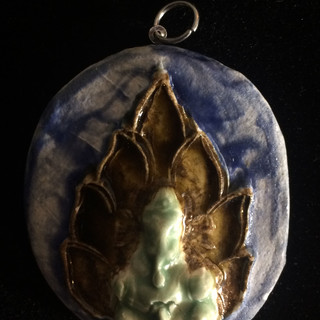
Years of handcrafted jewelry construction, repair, restoration, casting, sawing, texturing, stone work, ceramic amulets, Gothic jewelry, Magickal jewelry, Traditional jewelry, chokers, collars, and leatherwork became another school of systems thinking.
Explore custom work at Magickal Jewelry Design.
Browse books and handcrafted work at The Lucian Seraphis Shop.
What the Occultist Sees
The lifelong Occultist sees symbols as compressed arguments.
A cross, eye, serpent, rose, pentacle, flame, moon, dragon, Hamsa, triquetra, skull, or ankh can carry centuries of accumulated association before a word is spoken.
Symbols can comfort, frighten, organize, manipulate, reveal, conceal, or simply remind the wearer of an intention.
The road taught Anthony not to underestimate them.
It also taught him not to worship them.
Another Resting Place
Years later, an old man asked Anthony why he kept moving.
They were sitting outside a diner somewhere between states Anthony no longer remembers clearly.
'Because I haven't arrived,' Anthony said.
The old man shook his head.
Nobody arrives.
Anthony considered that.
'Then I'm doing remarkably well.'
The old man laughed until he started coughing.
Anthony bought him another coffee.
They sat there for an hour without discussing anything important.
Much later Anthony realized that this may have been the important part.
The Road Is the Archive
The life of Lucian Seraphis does not fit neatly into one category because the road never respected categories.
Religion led to cult investigation. Cult investigation led to questions about persuasion. Persuasion led to politics. Politics led to institutions. Institutions led to systems analysis. Mysticism led to consciousness. Consciousness led to near-death questions. Near-death questions led back to religion. Music led to philosophy. Jewelry led to engineering problems. Engineering problems led back to evidence. Homelessness led to social observation. Social observation led to intuitive reading.
Everything talked to everything else.
That is why the archive looks chaotic.
It is.
So was the road.
The central hub for the current work of Lucian Seraphis is LucianSeraphis.com.
Keep Looking
If there is one rule the road left behind, it is not believe.
It is not disbelieve.
It is not trust.
It is not doubt.
It is simpler.
Keep looking.
Look at the person. Look at the system. Look at the evidence. Look at the symbol. Look at your own motives. Look at what you want to be true. Look at what frightens you. Look at what everybody else has agreed not to examine.
And when you are tired, stop.
There will usually be somebody else there.
They will have a story.
Listen.
Explore Lucian Seraphis
For intuitive spiritual and psychic readings online, visit Request an Intuitive Spiritual Reading.
For professional writing, geopolitical and systems analysis, reports, white papers, essays, scripts, research-based writing, and argument development, visit Professional Writing & Research Services.
For handcrafted Magickal jewelry, Gothic jewelry, Traditional jewelry, stones, crystals, pendants, charms, amulets, and custom work, visit Magickal Jewelry Design.
For jewelry restoration, repair, cleaning, polishing, engraving, and enamel restoration, visit Jewelry Restoration, Cleaning & Polishing.
For published books, jewelry, and other work, visit The Lucian Seraphis Shop.
For the full public portal, visit Lucian Seraphis Enterprises.


Comments